Electoral Systems

Comparison of different electoral systems (FPTP, PR, MMP) in general elections.

FPTP (First Past The Post)PR (Proportional Representation)MMP (Mixed-Member Proportional)
Basic principleCandidate with the most votes wins.Seats allocated based on vote shares.Combines FPTP for seats with PR for overall proportionality.
RepresentationOften favors larger parties.Ensures proportional representation of all parties.Balances local representation and proportionality.
Voting systemVote for a candidate.Vote for a party.Vote for a candidate and a party.
AdvantagesSimple system, strong local representation.Fairer result, fewer wasted votes.Combines benefits of FPTP and PR.
DisadvantagesMany votes are wasted.Weak local representation.May still over-represent larger parties.
CountriesUK, US, Canada (federal level).Netherlands, Israel, South Africa.Germany, New Zealand.
Smaller parties, turnoutVoters of small parties are neglected.Voters of small parties can make an impact.Voters of small parties have some relevance.

Seat distribution between big parties

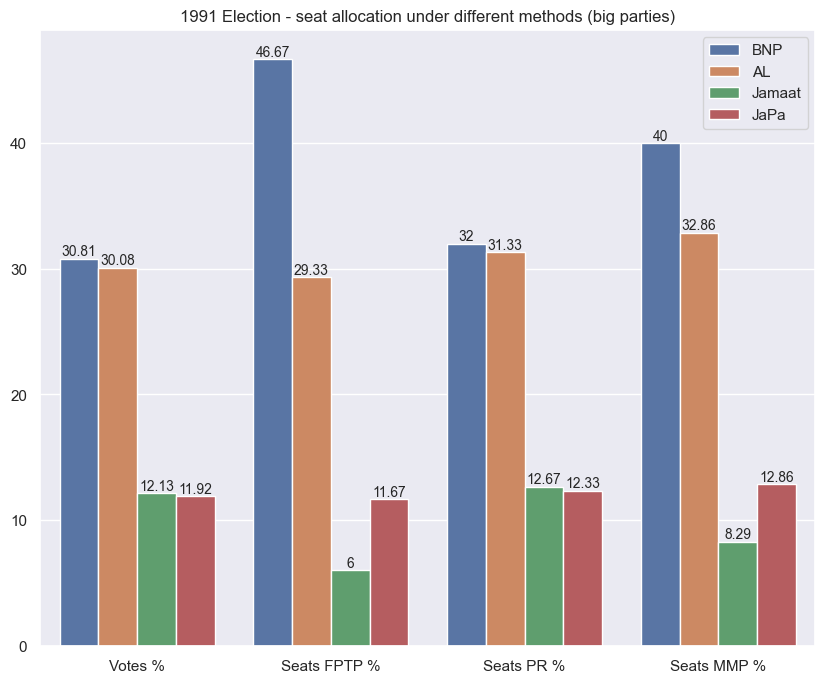
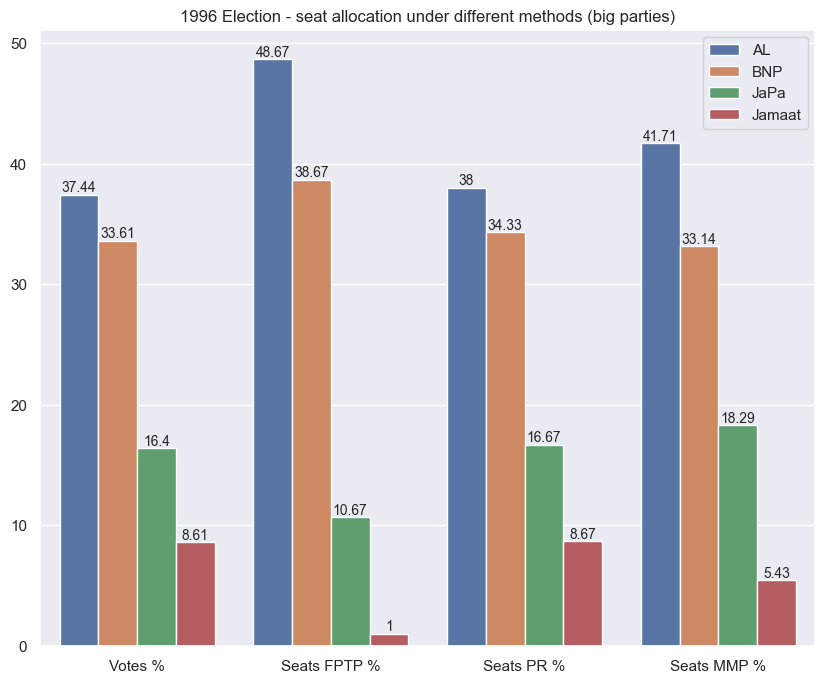
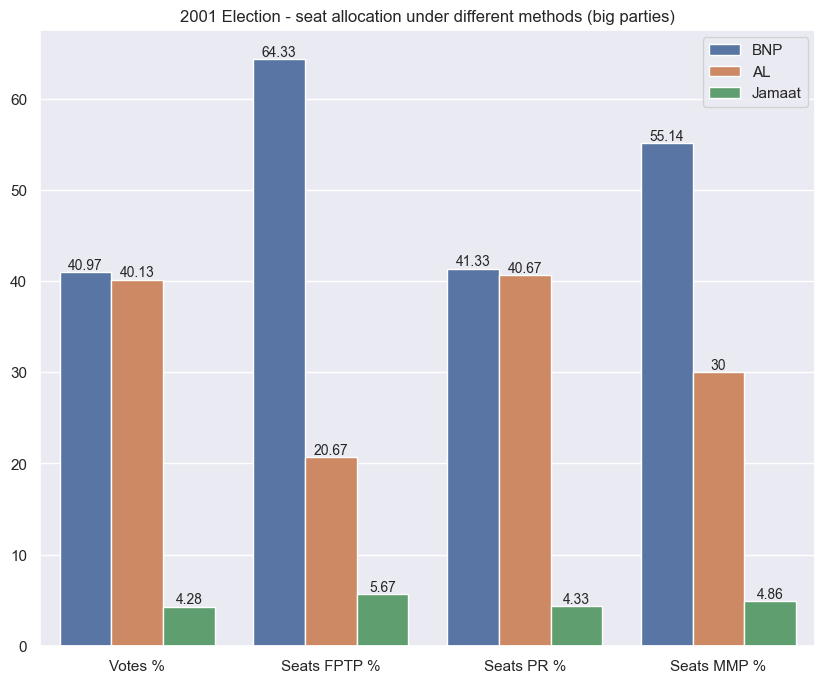
Big parties occupy almost the whole of the parliament seats. So, comparison of their seat distribution under different electoral systems paint the fundamental picture of how the parliament will look and how (im)balanced it will be.

Seat distribution between big parties
Insight

PR system is the closest to resemble the vote share of different parties in the parliament. But, if there's close contest in many seats in a two-party system, PR can form a parliament that's equally shared by both parties. It might slow down the policy-making process.

FPTP differs a lot from vote percentages, and strongly favors the party with the highest vote share. Notice the 2001 and 2008 elections, where AL and BNP respectively won around 20% less seats than their vote shares. In a two-party system, FPTP can give landslide victory to one party.

MMP balances between PR and FPTP. Though it does not closely resemble the vote shares, it creates a barrier to a landslide victory. People can vote and elect their local representative as-is, and parliament can also save itself from being one-sided.
Seat distribution between small parties

Small parties have almost no power in two-party systems except for helping one of the two big parties achieve majority and form the government. However, if one of the two major parties are out of election or are in major disadvantage, these small parties can play a significant role in determining the nature of the parliament. So, comparison of their seat distribution under different electoral systems is also needed.

Seat distribution between small parties
Insight

Just like that of big parties, PR system is the closest to resemble the vote share of small parties. FPTP and MMP can let a small party gain a seat even after getting less votes than needed to gain 1 seat.

Overall, the differences between different electoral systems for small parties are negligible.

Seat share comparison between big and small parties

What % of seats big and small parties get under different electoral systems tell us how inclusive and diverse the parliament will be and how easily small voices can make their way into the parliament.

Seat share comparison between big and small parties
Insight

Except PR system, other systems do not favor the small parties, rather FPTP and MMP make it hard for small parties to enter the parliament. Also, the political sphere got polarised gradually into the two-party system AL and BNP. It decreased the importance of smaller parties over time.

Seat distribution between big parties

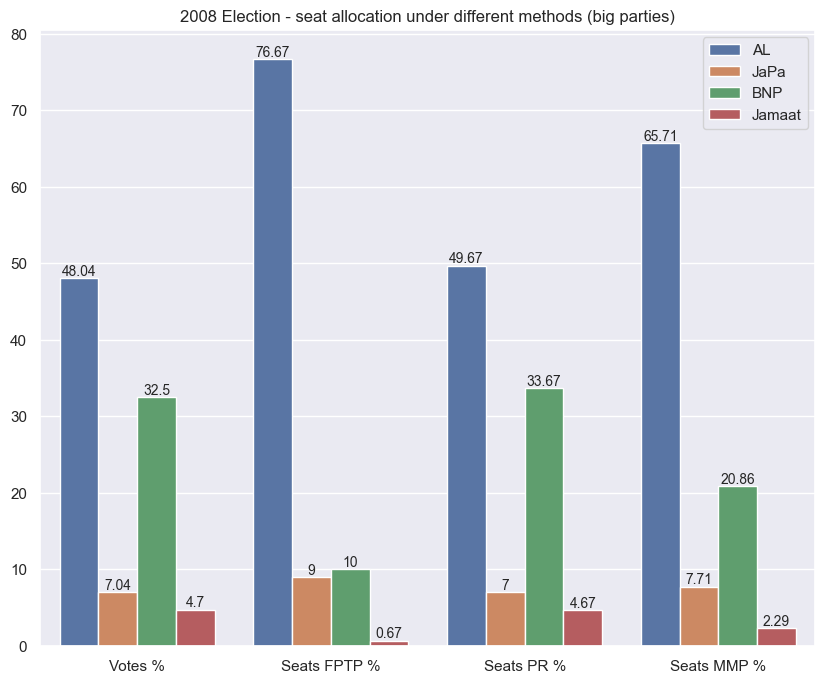
Big parties occupy almost the whole of the parliament seats. So, comparison of their seat distribution under different electoral systems paint the fundamental picture of how the parliament will look and how (im)balanced it will be.

Seat distribution between big parties
Insight

PR system is the closest to resemble the vote share of different parties in the parliament. But, if there's close contest in many seats in a two-party system, PR can form a parliament that's equally shared by both parties. It might slow down the policy-making process.

FPTP differs a lot from vote percentages, and strongly favors the party with the highest vote share. Notice the 2001 and 2008 elections, where AL and BNP respectively won around 20% less seats than their vote shares. In a two-party system, FPTP can give landslide victory to one party.

MMP balances between PR and FPTP. Though it does not closely resemble the vote shares, it creates a barrier to a landslide victory. People can vote and elect their local representative as-is, and parliament can also save itself from being one-sided.
Seat distribution between small parties

Small parties have almost no power in two-party systems except for helping one of the two big parties achieve majority and form the government. However, if one of the two major parties are out of election or are in major disadvantage, these small parties can play a significant role in determining the nature of the parliament. So, comparison of their seat distribution under different electoral systems is also needed.

Seat distribution between small parties
Insight

Just like that of big parties, PR system is the closest to resemble the vote share of small parties. FPTP and MMP can let a small party gain a seat even after getting less votes than needed to gain 1 seat.

Overall, the differences between different electoral systems for small parties are negligible.

Seat share comparison between big and small parties

What % of seats big and small parties get under different electoral systems tell us how inclusive and diverse the parliament will be and how easily small voices can make their way into the parliament.

Seat share comparison between big and small parties
Insight

Except PR system, other systems do not favor the small parties, rather FPTP and MMP make it hard for small parties to enter the parliament. Also, the political sphere got polarised gradually into the two-party system AL and BNP. It decreased the importance of smaller parties over time.

Seat distribution between big parties

Big parties occupy almost the whole of the parliament seats. So, comparison of their seat distribution under different electoral systems paint the fundamental picture of how the parliament will look and how (im)balanced it will be.

Seat distribution between big parties
Insight

PR system is the closest to resemble the vote share of different parties in the parliament. But, if there's close contest in many seats in a two-party system, PR can form a parliament that's equally shared by both parties. It might slow down the policy-making process.

FPTP differs a lot from vote percentages, and strongly favors the party with the highest vote share. Notice the 2001 and 2008 elections, where AL and BNP respectively won around 20% less seats than their vote shares. In a two-party system, FPTP can give landslide victory to one party.

MMP balances between PR and FPTP. Though it does not closely resemble the vote shares, it creates a barrier to a landslide victory. People can vote and elect their local representative as-is, and parliament can also save itself from being one-sided.

Seat distribution between small parties

Small parties have almost no power in two-party systems except for helping one of the two big parties achieve majority and form the government. However, if one of the two major parties are out of election or are in major disadvantage, these small parties can play a significant role in determining the nature of the parliament. So, comparison of their seat distribution under different electoral systems is also needed.

Seat distribution between small parties
Insight

Just like that of big parties, PR system is the closest to resemble the vote share of small parties. FPTP and MMP can let a small party gain a seat even after getting less votes than needed to gain 1 seat.

Overall, the differences between different electoral systems for small parties are negligible.

Seat share comparison between big and small parties

What % of seats big and small parties get under different electoral systems tell us how inclusive and diverse the parliament will be and how easily small voices can make their way into the parliament.

Seat share comparison between big and small parties
Insight

Except PR system, other systems do not favor the small parties, rather FPTP and MMP make it hard for small parties to enter the parliament. Also, the political sphere got polarised gradually into the two-party system AL and BNP. It decreased the importance of smaller parties over time.

Seat distribution between big parties

Big parties occupy almost the whole of the parliament seats. So, comparison of their seat distribution under different electoral systems paint the fundamental picture of how the parliament will look and how (im)balanced it will be.

Seat distribution between big parties
Insight

PR system is the closest to resemble the vote share of different parties in the parliament. But, if there's close contest in many seats in a two-party system, PR can form a parliament that's equally shared by both parties. It might slow down the policy-making process.

FPTP differs a lot from vote percentages, and strongly favors the party with the highest vote share. Notice the 2001 and 2008 elections, where AL and BNP respectively won around 20% less seats than their vote shares. In a two-party system, FPTP can give landslide victory to one party.

MMP balances between PR and FPTP. Though it does not closely resemble the vote shares, it creates a barrier to a landslide victory. People can vote and elect their local representative as-is, and parliament can also save itself from being one-sided.

Seat distribution between small parties

Small parties have almost no power in two-party systems except for helping one of the two big parties achieve majority and form the government. However, if one of the two major parties are out of election or are in major disadvantage, these small parties can play a significant role in determining the nature of the parliament. So, comparison of their seat distribution under different electoral systems is also needed.

Seat distribution between small parties
Insight

Just like that of big parties, PR system is the closest to resemble the vote share of small parties. FPTP and MMP can let a small party gain a seat even after getting less votes than needed to gain 1 seat.

Overall, the differences between different electoral systems for small parties are negligible.

Seat share comparison between big and small parties

What % of seats big and small parties get under different electoral systems tell us how inclusive and diverse the parliament will be and how easily small voices can make their way into the parliament.

Seat share comparison between big and small parties
Insight

Except PR system, other systems do not favor the small parties, rather FPTP and MMP make it hard for small parties to enter the parliament. Also, the political sphere got polarised gradually into the two-party system AL and BNP. It decreased the importance of smaller parties over time.